Integrated Capture and Conversion of Dilute CO2 Using an Oxygen Tolerant Porous Carbon Modified Gas Diffusion Electrode
Abstract
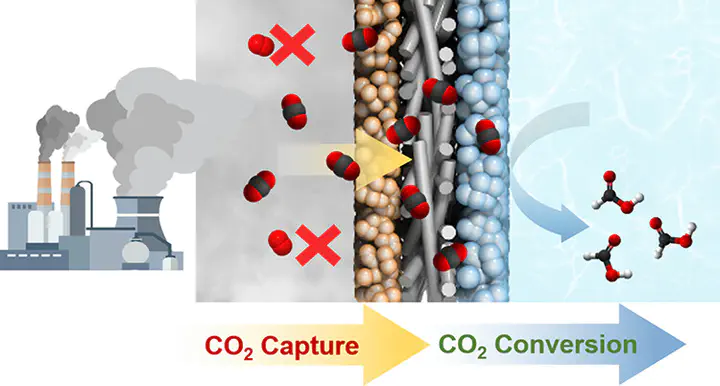
Integrated capture and conversion of low-concentration CO2 is a critical step toward carbon neutrality. Here, we demonstrate a gas diffusion electrode (GDE) modified with oxygen- and nitrogen-functionalized porous graphitic carbon (ONC) that enables efficient electroreduction of dilute CO2. Under 15% CO2 gas (without O2), the ONC-modified GDE achieved a CO2-to-formic acid conversion rate of 250 μmol/h·cm2, 2.5 times higher than that of the bare GDE, with a Faradaic efficiency (FE) of 98%. Even in flue gas containing 8% O2, the modified GDE achieved 22 μmol/h·cm2 formic acid production (8% FE) at −1.4 VRHE. Mechanistic and simulation studies revealed that the oxygen functional groups in ONC enhance CO2 adsorption while suppressing O2 permeation, imparting strong oxygen tolerance. In particular, the ONC-modified GDE remains active at a CO2 concentration as low as 1% and 400 ppm, suggesting potential applicability in integrated capture–conversion systems that utilize dilute CO2 streams from flue gas and ambient air.