Amorphous π-Conjugated Passivator Facilitates Widening Process Window for Reliable Perovskite Solar Modules
Abstract
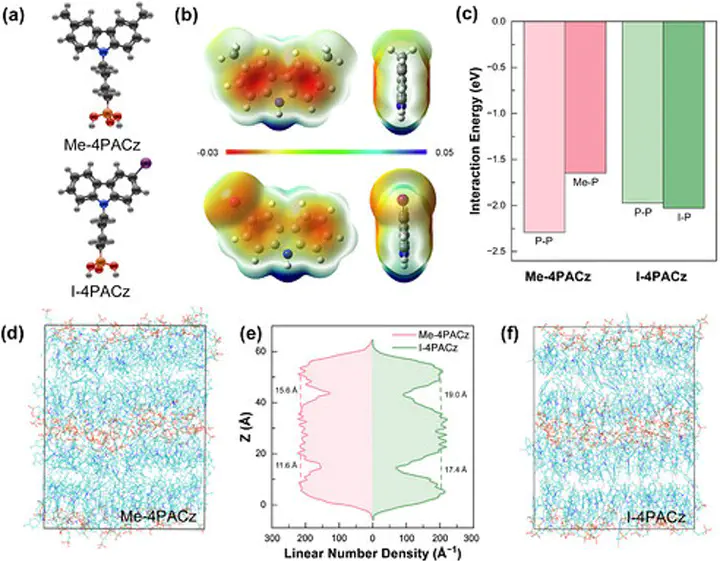
Although halide perovskite solar cells have achieved remarkable efficiencies close to their theoretical limits, durability against external factors and reproducible processing remain major barriers to commercialization. Conventional ammonium halide-based surface passivation strategies enable effective defect passivation and charge selectivity via 2D/3D heterostructure formation, but their metastability and strong sensitivity to processing conditions limit long-term stability and process window. In this work, we report an amorphous π-conjugated passivator, (4-(3-iodo-9H-carbazol-9-yl)butyl)phosphonic acid (I-4PACz). The asymmetric iodine substituent enhances the molecular dipole moment while simultaneously altering intermolecular interactions, thereby suppressing ordered molecular packing and enabling the formation of a uniform interfacial layer. The characteristics of I-4PACz result in efficient charge extraction as well as widening process window. Perovskite solar modules applied to I-4PACz as passivator between the perovskite and hole transport-layer show a power conversion efficiency of 21.2% with 24.5 cm² aperture size, and excellent long-term stability retaining 85% of the initial efficiency for 884 h under 65°C and 40% relative humidity, and 98.7% of the initial efficiency for 525 h under continuous illumination, respectively. Moreover, the minimal dependence on blade-coating speed also reinforces the suitability of this interfacial control strategy for inline and large-area manufacturing.