Rational Design of LiNi1-xFexO2 Electrodes for Enhanced Oxygen Evolution Reaction Under Power-Fluctuating Operations in Alkaline Water Electrolysis
Abstract
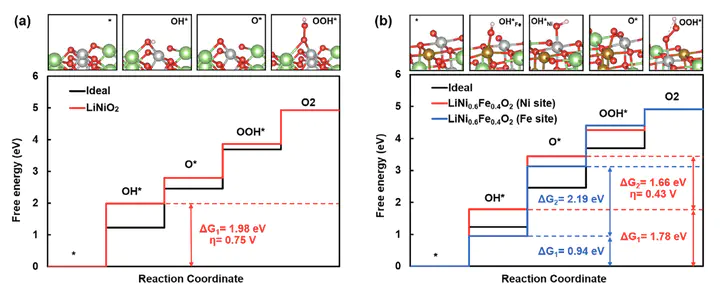
The electrochemical performance of alkaline water electrolyzers is hindered by power fluctuations when integrated with renewable energy sources in terms of electrode degradation. To address this, highly active and durable Fe-incorporated LiNiO2 oxygen evolution reaction (OER) electrodes were fabricated for power-fluctuating operations. The electrodes are synthesized through electrostatic spray deposition (ESD) as a one-step, binder-free, and scalable process. The electronic structure of LiNi1-xFexO2 was tuned by regulating the Ni and Fe content. This analysis suggests that optimal Fe incorporation raises the Ni oxidation state to Ni3+, which likely regulates the eg orbital filling, thereby enhancing OER activity. Density functional theory (DFT) calculations corroborate this electronic modulation and further indicate that the Fe incorporation reduces the theoretical overpotential, consistent with experimental observations. The optimized electrocatalyst, LiNi0.6Fe0.4O2, exhibits remarkable OER performance with an overpotential (246 mV@10 mA cm−2) and a Tafel slope (41 mV dec−1). During half-cell durability tests under various voltage cycling conditions, LiNi0.6Fe0.4O2 exhibits highly stable performance with insignificant degradation, attributed to stable maintenance of Ni3+. Moreover, the alkaline electrolyzer cell test achieved 87.7% voltage efficiency and stable operation for 200 h under power-fluctuating conditions. These results highlight the potential of LiNi0.6Fe0.4O2 for application under variable renewable power supplies.